Wednesday, June 08, 2005

My emulation of Lillian Hellman's memoir style

Stiff blue carpet and dark, wooden pews stretched across the expanse of the large church. My parents always chose to sit near the front on the right side. Even when we arrived almost late for ten o’clock Mass, my mother would rush my father, siblings and me up the aisle to squeeze into the last remaining spaces in the pew and crowd those already waiting there. Sometimes, when there was obvious space for a family of five, my mother would show a smug smile indicating how she perceived our invisibly reserved section, as if the other families knew not to sit there because we would eventually be coming.

What I also remember is the smooth-looking skin of the young, handsome priest and his brown eyes that resembled slightly melted M & M candies. He is the one standing next to me in the photograph which commemorates that rite of passage ordained for every second-grade child at St. Stephen’s the Martyr Catholic Church—the sacrament of Holy Communion, the First Eucharist.

I vaguely recall there were a few catechism lessons and practice sessions (how to place our hands—palms up, left one resting in the right like an oval candy dish), all of which were organized by a few religious education leaders and some parents. But how much could a group of seven and eight-year-olds really understand in regards to centuries old tradition and doctrinal teaching? It would be many years later until I finally started to understand the complicated theology of the Catholic Church. We were polite, though, as much as a group of white, suburban church kids are expected to be. Though I’m sure we shifted in our seats and picked our noses more than listened to the elementary-simplified explanations of this very important sacrament.

One thing I do remember well is the dress. I can still feel its crinkly pleated skirt and chiffon sleeves. Though I preferred sundresses and saltwater sandals, I knew this pristine white dress meant I was ready to receive the host—a small flat circle of processed bread-like ingredients, imprinted with a cross. This dress was like wearing an invisible palm over my mouth, I was such a good girl. To make my transformation as the “bride of Christ” complete, I also wore a small white plastic crown with an attached veil. But I didn’t feel holy or pious. Instead, I felt scratchy and confined. I submitted to my fate in the J.C.Penney department store girls’ fitting room. (Though I would realize that day of the sacramental Mass that I was merely playing the role, while inside I knew I perceived the divinity of Jesus in a more personal, relevant way.) At that moment in front of the three-way mirror, with my mother gushing over how beautiful I looked, I really did feel like a pre-pubescent bride. But it was all just a costume. This early veil-wearing experience would eventually ruin my desire to wear a wedding veil. Now all I can think of is how I already wore one and walked down the aisle, though I didn’t want to marry God; I just wanted him to love me.

It would be over ten years later, when I moved away for college, that I started to really define my own spirituality. Even though I would make more conscious decisions of the heart in junior high in regards to God, faith, and Creation, I didn’t have courage to change religious affiliations until I was eighteen. Even then, it was a fairly silent transition. I just didn’t go to Mass anymore. But I didn’t turn away from God; I simply started going with my college friends to the Presbyterian church that was within walking distance from our dorm. (None of us had a car, and it was the only church close enough to walk to, but they also warmly reached out to the college students.) I also joined “The INN”—a college ministry that met on Tuesday evenings. Their gatherings featured a worship band, overhead transparencies with the song lyrics, and intellectual, application-based teaching by a pastor named Mike. I embraced this new mode of religion, of grace and spirituality, because at age 7, I didn’t know what I was doing. I didn’t have a choice. I realized even at the time that the rituals, especially that processional of small brides and grooms, was more for our parents, as evidence they were raising good Catholic children and keeping a good Catholic home.

At age seven, I didn’t even know about fractions yet, how could I understand the Holy Trinity and the metaphysical transformation of bread to flesh, wine to blood? I didn’t revere the sacrament. I remember feeling more nervous and slightly scared, actually. I only cared about no longer being left behind in the pew while my parents and older siblings took Communion every Sunday at Mass. I wanted to swallow wine. I wanted to place God on my tongue and digest his body.

Though I understood the implied mystery of this ritual and the significance of my initiation into the sacrament, I didn’t learn to appreciate the symbolism of it until much later. It was at “The INN” one night before spring break with candles, acoustic guitar music, and surrounded by my closest friends. Pastor Mike ripped a sourdough mound of bread in half, like the round loaf found in the grocery store bakery section, and he said the same words of Jesus and the handsome priest. Then Mike placed the bread on the large wooden table at the front of the church sanctuary, next to two cups—one labeled wine, the other grape juice. Then in reverent fashion, we walked individually to the front to have our own moment with God. That night I walked to Him, tore off a wispy piece of bread, dipped one corner into the cup of wine and ate it. Rather than being compelled by tradition and family expectation, this moment was an act of love.

When I look back on the photographs from that First Eucharist Mass in the spring of 1982, I see the distinct discomfort on my face. I’m not smiling with my teeth showing like I normally do. Instead, my lower lip is biting my upper lip on one side. My hands are clasped tightly together, knuckles turning white, and one foot and ankle is rolled outward, so the sole of my shoe stares at its mate. The handsome priest has his right arm gently resting around me with his hand on my shoulder. He has a slow smile, like an awkward too-tall groom. He was maybe thirty-years-old and did not realize how many years away I was from really being married.
**Note on Form: use of flash-forwards, treatment of authorial self vs. narrative self, and tone is meant to emulate what Hellman does in her first memoir, An Unfinished Woman. This was turned in as a three-page, double-spaced essay for Nonfiction II final, along with a five-page essay analyzing Hellman's nonfiction technique and style.

Tuesday, June 07, 2005

comments, please?

...if you're stopping by...won't you? You don't have to...but I see my stats and kind of wonder who actually stops and reads (since there are 311 unique visitors so far)...what do you think about what you read here? Would you come back again? (Some of you do.)

So, if you are not too shy, please comment on something you like, offer some insight or advice, book recommendations, etc. Since I'll soon be a post-MFA student, the content will be changing slightly...if you are a fellow writer, please tell me what you do to keep yourself accountable, motivated, inspired...what works and doesn't work for you; what are your favorite literary websites and journals; what are you reading; where are you submitting work; where are you being published, and so on...

After I find a new place to live, I'm going to start sending out poems (or at least get the submission packets ready to send out in the fall) to literary magazines. First on my list are: Prairie Schooner, Artful Dodge, Denver Colorado, and Colorado Review. (subject to change, of course)

Today I made final changes to my thesis manuscript. Rearranged the order of contents a little bit, revised a line here and there, took out 2 poems that I feel need more revision still and feel disconnected from the rest of the manuscript because of their need to be polished just a bit more. I'm heading out soon to the Spokane Center's computer lab to use their laser printer, then will take my required 4 copies (for binding) to the Graduate Studies Office in Cheney tomorrow morning.

Then...I have some Willow Springs submissions to read and turn into the editors. Then...I will be completely done with all of the requirements for the completion of my Masters of Fine Arts degree. Whoo-hoo!

This weekend:
* MFA graduate reading this Friday night at Center Stage
* Graduate Commencement, Saturday afternoon in Cheney . . . Jonathan is "hooding us"

Friday, June 03, 2005

what we look for

I find it funny and fascinating that people have found my blog when they typed these phrases into search engines:
  • ralph waldo emerson and ladybugs
  • poetry is a passion not a habit
  • clip art husky head

These three have been the most interesting by far. Fun!

And I'm currently procrastinating from finishing my very, very last final paper for my graduate school career. It's a bit sad, though it's more exciting to feel the celebratory feelings that comes with accomplishing this 2 year commitment that has consumed my life both emotionally, financially, and creatively.

Last night, before my last class session ended the teacher had some parting words to say to commorate the end...(unfortunately, we haven't had our regular professor for quite a few weeks due to illness and surgery...sure missed learning from her this quarter, but oh well...just praying that her health improves)...anyway, Kristen warned/encouraged (who's only 25 with a first book out...got her MA in Creative Writing at UC-Davis) us that our writing life will be definitely be different once we are separated from "the program"...and that (well, at least this was true for her) we would have to learn to write again...meaning, without the crutch of workshop, an advisor, the creative stimulation of our classmates/fellow writers, deadlines, and structured writing, well...we have to kind of figure it out again, that is, answer: "Well, what do I do now?"

For me, that means...how do I figure out a writing schedule while I work a 30-40 hour/week job that pays the bills. Who will be my post-MFA workshop comrades?...those poet friends who will be the ones we share poems with (for response and critique, either by email/mail or phone). And now that I have a manuscript, what will I do with it? (the plan now: submit poems to literary magazines, something I just did not have time for this school year...continue revising and working them). I also have some poems that I did not include in my thesis because they were not revised enough, and I needed more space from them...so I look forward to working on those. Plus, I have a bunch of new ideas that I'd like to get some drafts started. And now that I studied all my thesis books with such depth, I want to work on some of my poems while paying attention to some of those craft ideas that I admired in others' work (keeping Halliday, Kasdorf, and Morling in mind, especially).

And I want to write more non-fiction essays and learn more about that craft.

And Jonathan is teaching a fun course in the fall (which hasn't been offered in 3 years), "Literature of the Pacific Northwest"...so I hope to sit in on that class a time or two, get the syllabus, and possibly go on the "field trip" (a literary journey to Montana to visit Richard Hugo's towns and bars from his poems).

Anyway, for now...one more final...the last one. Due Monday by noon.

Thursday, June 02, 2005

I passed!

A successful oral examination (thesis defense) was completed yesterday...in the hot seat from 3:00-4:00 p.m. Celebrated with friends afterwards at The Steam Plant Grill. I've been overloaded with reading, skimming, and reviewing my thesis list of poetry books, making notecard notes (which I didn't even really refer to during my defense). I used tons of little post-it flags to mark poems in each book that I would discuss, as needed during the course of the discussion. I definitely over-prepared in ways that weren't necessary, ultimately...but there was no way to know what I would be asked to recall, respond to, etc. I was hoping to talk more about Richard Hugo and James Wright, but ended up focusing on Halliday (his sincerity), Kasdorf (her subject matter, and construction of her book), with some Franz Wright (his sincerity vs. Halliday's) and Jack Gilbert (one of his lyric poems, vs. his narrative)...and then finally, some Malena Morling and discussion of her as a lyric poet.

Now that the major part is finished, I just have to polish up the manuscript, make a few changes (one title change, some possible rearranging of the order of poems), a few typos to fix (mainly hyphen additions and spacing issues)--then copy a nice laser-printed draft onto the thesis paper and take those 4 copies into the EWU Graduate Studies office in Cheney by 5pm on June 10th.

But until then...I still have a final for my nonfiction form/theory class to complete. Then, THEN...the blissful feeling of MFA completion will fully come!

P.S. Best part of preparing for my defense: reading Richard Hugo along the East Fork of the Bull River in Montana while camping with Emerson and my fiance for a few days over Memorial Weekend. A lovely time!

Tuesday, May 24, 2005


inspiration for a cover page

fascinating!

Monday, May 23, 2005

Feeling like Annie Dillard


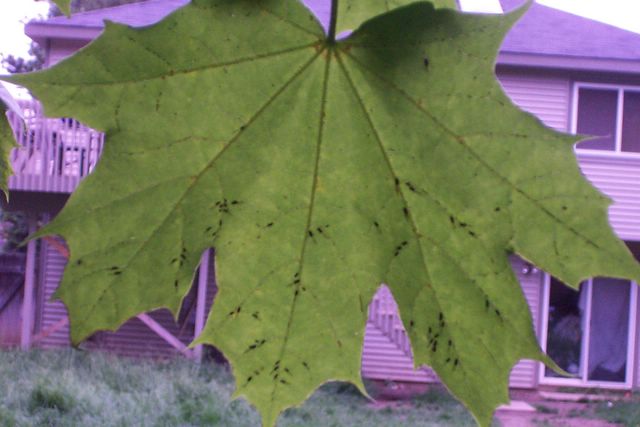
the maple bug tree

see the little insects with their little wings
hiding on the underside of the leaf
shelter from the rain and sun
each day they multiply, never seem to fly away

Emerson's husky hair, soft as cotton when his undercoat sheds, the birds snatch it from the grass to make their nests, his springtime "blow out" and the subsequent big brush-out filled a entire bucket with airy, fluffy fur...I set the bucket on top of the fence next to a tree branch as an all-you-can-get buffet for the birds

Sunday, May 22, 2005

that collective 15% Midwest is from North Dakota


Your Linguistic Profile:


80% General American English

10% Upper Midwestern

5% Midwestern

5% Yankee

0% Dixie


Saturday, May 21, 2005

Rib Space

Now I want to be whoever I was at that moment
when I discovered my own breathing . . . .

— Malena Mörling, Ocean Avenue

. . . the soul
is nailed to us like lentils and fatty bacon lodged
under the ribs.

— Jack Gilbert, The Great Fires

. . . let me learn for myself all the desires
a body can hold, how they grow stronger
and wilder with age, tugging in every direction
until it feels my sternum might split
like Adam’s when Eve stepped out,
sloughing off ribs.

— Julia Kasdorf, Eve’s Striptease


(epigraphs used to intro my thesis poems)

cool

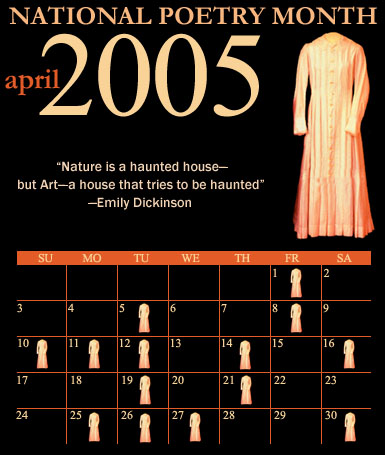
http://www.openpoetrybooks.com/calendar/

Sunday, June 05, 2005 at 04:00 PM EASTERN WA. MFA STUDENTS

For some years now, representatives from EWU's graduating class of MFA students have made the trek over the mountains to share their work with those of us on the wet (well, it used to be) side of the state. Charmingly and insightfully presented by their professor Jonathan Johnson, the readers this afternoon will be Amy Silbernagel, Jeff Dodd, Shannon Amidon, Agatha Beins, Elise Gregory, and Emily Benson.

Thursday, May 19, 2005

Thesis is done!

... and all copies were delivered by Wed. afternoon to my readers (who are my thesis committee members). Phase I is complete...such a good feeling!
Even Emerson is happy!

Thesis Book List (final version)

  1. Julia Kasdorf - Sleeping Preacher
  2. Denise Duhamel - The Star-Spangled Banner
  3. Malena Mörling - Ocean Avenue
  4. Dorianne Laux - Awake
  5. Ann Townsend - Dime Store Erotics
  6. Kim Addonizio - Tell Me
  7. Richard Hugo - The Lady at Kicking Horse Reservoir [1]
  8. James Wright - The Branch Will Not Break [2]
  9. Galway Kinnell - The Book of Nightmares
  10. Jack Gilbert - The Great Fires
  11. Tony Hoaglund - What Narcissism Means To Me
  12. Mark Halliday - Selfwolf
  13. Phillip Levine - What Work Is
  14. Franz Wright - The Beforelife
  15. James Harms - Modern Ocean

[1] from Making Certain It Goes On: The Collected Poems of Richard Hugo
[2] from Above the River: The Complete Poems

Alternates:

  • Paul Guest - Resurrection of the Body and the Ruin of the World
  • Sandra Alcosser - Except by Nature
  • Campbell McGrath - American Noise
  • Richard Hugo - Triggering Town (prose)
  • ­Elizabeth Bishop - Geography III (from The Complete Poems)
  • Mary Oliver - Dream Work --or-- New and Selected Poems ©1992
  • Jeffrey McDaniel - Alibi School

Monday, May 16, 2005

raining again today

This weekend saw unusual amounts of hard rain...and I mean really hard rain, just pouring, which rarely happens here. So it's condusive for reading inside, going to the mall and doing registry stuff, working on a book of poems, reading books of poems.

I've seen only glimpses of the Spokane Falls while driving over the Maple Street bridge. The speed limit is 40 mph on the bridge, but I steal glances to the right to see them crashing just near the Monroe Street bridge. I'm very excited for that bridge to be done with its renovation project. It's been going on since the very first time I scoped out Spokane in July of 2003. So, the river is high, the falls are powerful, the drought conditions are not so bad anymore ... waterskiing conditions this summer should be good.

Saturday, May 14, 2005

almost finished

(amy’s thesis title goes here)

A Thesis

Presented To

Eastern Washington University

Cheney, Washington


In Partial Fulfillment of the Requirements

for the Degree

Master of Fine Arts, Creative Writing


Spring 2005
* * *
...need to figure out the final order of poems. I am going to lay them all out on the floor or stick them to the wall and pray that a title arises from the lines, and an inspired table of contents is born. Was up until 4:30 am tinkering, revising, organizing, and printing it all out, trying to do what a tired but still fairly high-functioning creative and inspired mind could do.

Thursday, May 12, 2005

Open Books

Eastern Washington University MFA Poetry students will be reading from their thesis books on Sunday, June 5th at 4:00 at Open Books in Seattle.

6 poets will be reading, including me.

(still not sure if I can make it over next Tues. to see Franz....thesis is due that Wed...gotta finish the formatting, revise about 5 more poems, + revise another 5 with minor tweaking, and read/skim a few more poetry books to make final decisions about what will be included on my thesis reading list...oh, and I need to come up with a title! whew!)

Monday, May 09, 2005

slow-motion

Ever have one of those days where it feels like you can't move fast enough? Where it seems like everything is taking longer than it should be? Like your mind is moving a faster rate than your body is willing or even able to do? You're continually planning out and envisioning the next 60 seconds of your life and you just can't keep up?

Well, that's what today felt like. It seemed like I couldn't even refill my dog's water bowl as fast as I wanted to. I was impatient with each present task, knowing there were so many more to do. There was no seconds to waste.

Thesis anxiety is kicking in as the final 8 days approach to the deadline to give a complete photocopied manuscript to each of my committee members. At that time, I also need to provide them with a confirmed list of my thesis book list--15 titles in all. My oh my.

It will all get done...the optimistic corner of my brain knows that and repeatedly chants this to myself. I might be wearing the same cycle of clothes and not brushing my hair very often over this next week, but the thesis will get done. It has to. Sleep can always be sacrificed.

Yet, the quarter still moves on...and I'm attempting to keep up with the reading for my NF form/theory class. I'm liking Annie Dillard's Pilgrim at Tinker Creek, however, I'm only getting her in short doses so far. Tomorrow, I'm planning to read the book in larger chunks of time. On Saturday evening as I was reading the book and marking passages and lines I liked with a newly-sharpened pencil, my fiance's 4-year-old niece Emma (and my future wedding flowergirl) came alongside my chair and said to me, "You're writing in your Bible?!" I guess it is a pretty thick book...but I explained to her that it was a story book for school. "You go to school?!" she exclaimed. Emma goes to pre-school and has recently learned all about ladybugs--their wings, life cycle, etc. (Her rich and vibrant vocabularly rivals the men in the family.)

As I explained that I go to college, just like her mommy and daddy went to college, she paused to exclaim (most statements are a genuine exclamation for Emma), "My mommy and daddy went to college?!" I'm not sure what Emma's concept of college is.

Considering that Dillard is fairly spiritual (I learned that she was raised Presbyterian than converted to Catholicism as an adult), Emma's question about me writing in my Bible is interesting.

Nonetheless, I was quickly swayed into playing with Emma. What adult can resist a cute little girl asking, "Do you want to play with me?" She led me downstairs to the playroom and we enjoyed multiple rounds of "Simon Says." She let me go first at being "Simon" and she rotated our turns equally. My favorite of her requests, "Simon says: pretend like you're buckling your shoes." Then we played hide-n-seek, my personal favorite. The first time I was "it", I had to count to 5 and 1/2. I tried to pretend like I didn't know where she was hiding, though it was obvious from the sounds that she was behind the chair in the same room we were in. So, as I pretended to look for her under the table, she squealed, "I'm behind the chair!" The next time it was my turn to count, I had to count to 33. Obviously, she had a much tougher hiding place in mind. But before I could really look for her, she called out, "I'm in Papa's closet!" Oh, the joy of being four years old. That sweet, simple exhiliration of hide-n-seek. The suspense of waiting in a special hiding place and then the "surprise" of being found.

As a result, Dillard received little of my attention the rest of that evening.

This week I'm also reading Paul Guest's first book of poetry, The Resurrection of the Body and the Ruin of the World. Paul has a recent poem on Slate, and also has a blog! So far I'm only on page 33 of his book, but am enjoying it--as Jonathan said I would. I'll discuss it more with him on Thursday for our second thesis advising meeting this week.

Good night! It's one of those rare evenings in Spokane where it's raining really, really hard. It's like Seattle. Ah.

Friday, May 06, 2005

parody

I read about this in the paper, and had to visit the Wal-Mart parody website for myself. Great job to the college kid who did all this!

I read Nickeled and Dimed: On (Not) Getting By in America in the spring of 2003. I rarely shopped at Wal-Mart anyway, but after reading Barbara Ehrenreich's book I made a more informed decision to not support their corporation every again. (Sadly, the great novel and movie Where the Heart Is ends up glorifying the business in a spoof-like way.)

I admit, however, that I've shopped there at least 2 times since reading the book: once because I received a $50 gift card for a Christmas present and I bought much-needed groceries there, and another time I bought the Friends DVD there for my fiance's birthday present (it was the cheapest price I could find, except Amazon but I didn't have time to buy it from them), Valentine's Day boxers, and a pint of raspberry sorbet. (Really, what other store would allow me to purchase all of these items in one trip? Okay, maybe Fred Meyer.) I felt sort of bad about this second purchase, but it was also a financial relief to my budget in a way. However, I'm happy to say I've been "Wal-Mart Free" for over three months now, and I don't plan to go back. That's right. Never, ever again.

I've been trying to get my mom to stop shopping at this mega-retail giant and read Ehrenreich's book because she's a big Wal-Mart fan, but so far I've been unsuccessful. The store was next to the "Super Mall" so what could I do? And now a new one opened up this winter that's even closer to her house! Wal-Mart is the new K-Mart. I didn't grow up with Wal-Mart like kids in the South did, or like my nieces have now. Washington state kids in the 1980's didn't like to admit their mothers shopped there, and we took our P.E. clothes to school in the best plastic bags we could find (The Bon or Nordstrom were the coolest, the specialized bags from their junior departments). I remember quickly grabbing a bag from the pantry and only finding out later when I was at school that it was a K-Mart one. I was mortified and made sure no one saw it!!

Thursday, May 05, 2005

bad poem

Just for the record, I don't think "Kissing John McPhee" is a good poem. It would get an enthusiastic rejection from me if it were to be submitted to Willow Springs. It's sentimental, melodramatic, and its predictable details about McPhee's life as a writer sucks any intriguing tension that might otherwise exist between the speaker and the situation. I don't think it's trying to be ironic or sarcastic, it seems to be a sincere attempt to be a form of author-worship, which makes it all the more cheesy. And the fact that McPhee wrote for The New Yorker, and just recently had a new essay published in it, makes it all the more cheesy. But, I must admit, you gotta admire a writer who writes poems for other writers and submits them to a magazine as big and prestigous as THE NEW YORKER!! And then documents (announces?) those submissions and rejections on her own blog! Now, that takes guts. (I'll keep my bad poems and rejection slips to myself, thank you very much.)

After NF form/theory class tonight and Jeremy's presentation on McPhee and his book (The Survival of the Bark Canoe), Jeremy suggested I write my own version of "Kissing John McPhee." I considered, but instead thought I'd rather write a poem called "Kissing Henri" (pronounced "on-ree", for those like me who aren't familiar with French names). But now it's late, and I can't muster the energy to write it, even though I drank Mountain Dew during class.

But if I were to write about my experience of reading McPhee's nonfiction book for class, it might go something like this...

Kissing Henri

Maine's wilderness and Thoreau, and now this:
sympathetic portrait
of twenty-five year old Henri,
lonely in his art, unmarried and still living
with his parents in his New Hampshire hometown.
He carved wood, remembered the best trees,
was obsessed with only this.
A white man seeking
mastery of the Indian bark-canoe.
I know it's hard to let go what you create.
Green beef jerkey breath,
faint orange stain
of Tang on your lips
and pressed
into the side creases
of your mouth,
please paddle faster for me.

Nonfiction Book of the Week


Subgenre: Research-Based Literary Nonfiction

MFA choices

If I had to start all over, if I hadn't been at Eastern the past two years, I would strongly consider this program. A very intriguing philosophy. At the same time, any MFA program is what the writer makes of it. In my MFA program, I've been fortunate to have a number of classmates who also write from the foundations of the Judeo-Christian belief system. Though I wish there was greater opportunity for more organized discussion about this, it's come up. In Poetry II, Modernism Form & Theory, some of these ideas came up. And anytime a text alludes to Biblical themes or characters, this has been discussed.

One thing I know for sure, I love the residency MFA program. Moving to a new city to join a community of writers (while also making a newer community, as the incoming group of students), the bi-quarterly "Voice Over" events, the visiting writers, the after-parties, meeting for class each week, the internships (the university press, teaching/Writers in the Community, and literary magazine editing), the literary magazine editor meetings, meeting classmates for coffee, going for runs together, being immersed in the culture of writing...this is only possible with a program where we all come together face to face to live the writing life...especially for someone like me, who I would consider to be not such a traditional graduate student. I started grad school at age 28 (almost 29) after having a full-time public school teaching career for 5 years + a one-year sabbatical (hiatus/escape was more like it!) from the English classroom to work at a Christian camp for a year (marketing & promotions) . I didn't come right from my undergraduate studies, or come after obtaining a different master's degree first. I needed the routine, the motivation of community, the regular social interaction with professors and classmates. I have a friend in a low-residency MFA program for creative non-fiction. It wasn't her first choice, but her and her husband had established jobs in Seattle (hers already involved writing...to pay the bills).

Unless one chooses the research-based UW program or the UW certificate-program (not a credited degree, and far from an MFA course of study), then the choices were limited to low-residency programs. Now, Seattle area writers who want to pursue their MFA can choose from SPU's newly-created MFA program, the low-residency at PLU (which only began in 2004), move to Bellingham and get a MA in English with a Creative Writing emphasis at WWU, come to Eastern, pursue an out-of-state low-residency program or move out of state for a residency MFA program.

Sadly, I'm not quite ready for my experience to end. I now know why it's not such a bad thing to extend the thesis another quarter.

More MFA food for thought:

Wednesday, May 04, 2005

Franz Wright is coming to Seattle

Franz Wright, winner of the Second Annual Denise Levertov Award from Image Journal of the Arts and Religion speaks on Tuesday, May 17 at 7:30 pm at the Seattle Art Museum. Free. Public reception, celebration and booksigning follows.

For more information, see http://www.imagejournal.org/news/local.asp

"Image journal and the Department of English at Seattle Pacific University established the Levertov Award to honor one of the twentieth century's greatest poets. Levertov, who spent her last years in Seattle , embraced the landscape and culture of the Pacific Northwest. Levertov's identity as a Christian believer—a pilgrim whose faith was inextricably entwined with doubt—became another important facet of her work, particularly in her later poetry.

The Levertov Award is given annually to an artist or creative writer whose work exemplifies a serious and sustained engagement with the Judeo-Christian tradition."

Monday, May 02, 2005

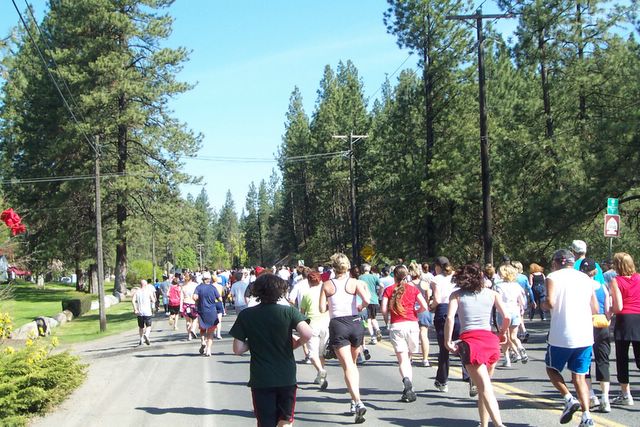
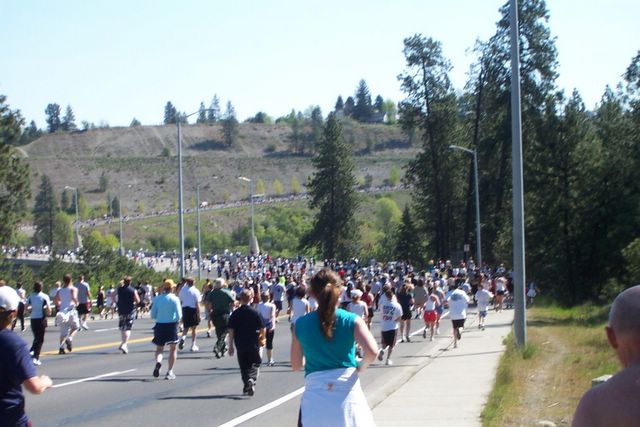
Bloomsday 2005


tranquil Riverfront Park, the day before Bloomsday

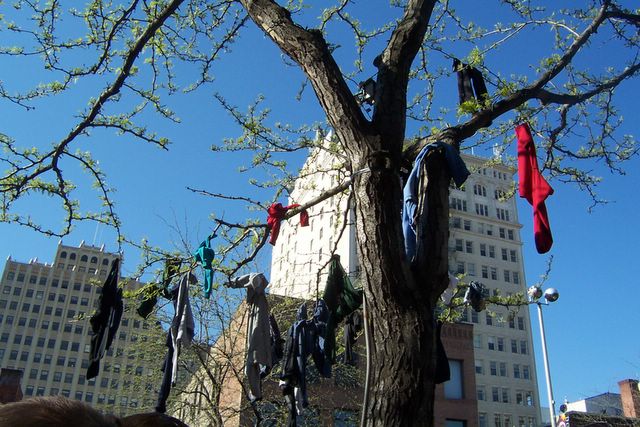
clothesline: Sunday, May 1 @ 8:30 am

our view from the starting area

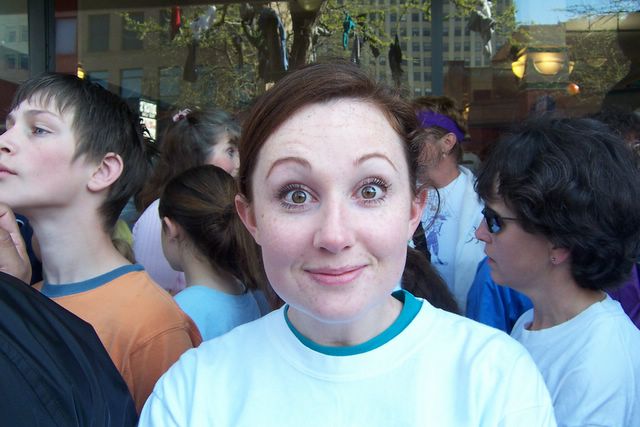
the look of a first-time Bloomie!

going up Cemetery Hill

entering Spokane

approaching Doomsday Hill

finish line

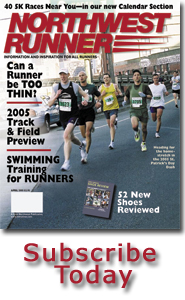
Judd took our "finisher" pictures...we all looked marvelous and had a wonderful time. Check out the upcoming June issue of Northwest Runner magazine for my Bloomsday article and an interview with Don Kardong, this year's new Race Director and Bloomsday Race Founder/former Olympian.

Thursday, April 28, 2005

bizness of writing (get to work!)

I'll be writing an article about Don Kardong & Bloomsday, which is due to my editor/publisher by May 9th. Don called me last night and we tentatively have an interview set up for the Wednesday after the race, which is this Sunday. I'll need to take notes at the trade show Friday night and since Don gave me his cell phone number to contact him during the busy race weekend, I'd like to track him down and take his picture--preferably on race day...even sweeter if it was post-race with the overall winners, but even better if it was a picture of Don with the top male and female finishers who are Washingtonians, or at least from the Northwest since it is for Northwest Runner magazine. But I'll still be on the course during the awards ceremony, most likely, since the elite runners finish the 12k course in awesome time. And I'm not willing to give up my entry (and not get the finisher shirt!) just for the sake of journalism!

In the meantime, poetry, poetry, memoir, poetry, non-fiction, poetry, poetry, poetry...

POETRY THESIS MANUSCRIPT DUE IN 20 DAYS!

My reading list is moving right along...in fact, I keep reading more and adding more books to the list. The most difficult part will be deciding which 15 to keep on the list.

And I recently finished Modern Ocean the first book of poems published by James Harms. I LOVED it!! Really intriguing poems, what I would defend as being narrative lyric poems, mostly about growing up and living in San Diego CA. The setting is there, but the culture and family around the speaker of these poems is what is most engaging, and which is the core of the subject. There is a balanced mixture of light and dark (as in the yin/yang//good/evil emotional forces of life and human experience). Harms is a master of subtle emotional tensions, understating the conflict to really pull the reader into his poems and construct a co-experience...as I read, I felt like I was discovering meaning alongside the speaker--a co-creator of the experience, through the poet's use of point of view and tense. Wow! I'm excited to share with Jonathan how much I really, really loved this book! I see much of what I'm attempting to do in my own work, being done in Harms' book. He nails it right on.

Monday, April 25, 2005

Memoir

I've enjoyed researching and studying the nonfiction subgenre of memoir, in preparation for an informal presentation that a classmate and I are preparing for Thursday night's theory class. The text basis for our discussion is A Unfinished Woman by Lillian Hellman, a controversial memoir.

I'd like to re-read some of the memoirs that I've read in the past (such as A Girl Named Zippy by Haven Kimmel). I read them without really considering it's authentic literary value beyond the pure entertainment of the narrative and characters. Moreover, I never thought to seriously question how or why the memoir was being written. I read with an easy kind of faith.

Here are some of the websites where we've gathered information from:

and for any teachers out there... a high school memoir writing unit plan

thesis bond paper

For those Spokanites who are writing your thesis this quarter or in the near future, here's a place to purchase your 100% cotton thesis bond paper. I'm not exactly sure if Paper Plus is cheaper than the school bookstore, but if you buy it on a Monday and mention the Spirit 101.9 fm radio ad, you get an extra 10% off. A pack of 500 sheets (of 24 lb text weight) is $32.35, before the discount.

Friday, April 22, 2005

Sedaris slept overnight in Spokane

First...I admit it: I sometimes plan too many things for one day, my To Do is a tad unrealistic. I'm optimistic and underestimate the time needed and the actual time I have. I overestimate my stamina and ability to stay focused and on-task; other opportunities arise and I say "yes" to them.

But I did meet David Sedaris yesterday. He is smaller than I imagined him to be. Shorter, yes, but also just a smaller presence (maybe small head, too), and smaller-boned, which doesn't seem to fit his writing which is bold and declarative and in-your-face funny. And the pictures of him on the back of his book make him look tall and skinny. But really, he's just skinny and kind of short, for a guy. (See Jeremy's pictures.)

I took a brief break from taking tickets at the door and cut in line in front of Ashley (another MFA poet) to ask Sedaris to sign my copy of Barrel Fever. (Before leaving my house, after franticly looking for my copy of Holidays on Ice, I remembered that I loaned it to my mother and it's still sitting on the guest-room dresser at their house near Seattle.)

Sedaris asked me, "What's that smell? You smell 'fresh'." I was confused for a second, then felt somewhat embarrased when I remembered that I had sprayed some Victoria Secret's "Love Spell" (the purple bottle) on my skin. My fiance hates it, says it smells like canteloupe and he hates canteloupe. He calls it "Love Repell" and so I only wear it when I'm not going to be anywhere near my fiance. That's why I impulsively put a little on before dashing downtown. (I only have a little over three months to use up the last of it.)

So I ended up telling Sedaris the whole story behind the smell. He chuckled as put two mushroom stamps on the title page of my book (my copy of his book) and signed it for me. I thought he might mention something about me having the same name as his sister, and how much he loves that name. But he didn't. Instead, I blabbed about "Love Spell" as the next five people in line heard my story as well. I think a fit of nervousness came over me. But at least I made Sedaris laugh!

During the Q & A, he talked about how he likes to ask a question of each person who asks him to sign a book. Maybe he'll put our encounter in his diary and read that at a future reading.

April 22, 2005: Spokane, WA
This woman in the book signing line came up to me and smelled, so I asked her, "What's that smell?" . . . .

Hopefully he didn't find it repulsive. He did roll his eyes around in circles when I told him it was called "Love Spell" as if to mimic its name. He probably did find it bearable, at least, or else he wouldn't have brought it up.

Which reminds me that I had to sit near a really smell man throughout the entire Sedaris reading, and it burned my eyes. As a volunteer, I didn't have a seat for the sold-out show. So I had to either stand in the back or sit on the floor. I found a little nook in the back handicapped section, which was actually used for overflow seating. I was told there would be no late seating, but during the second essay or so this man was escorted into our area and given a metal seat (like those found in church basements) to sit on. It was too dark to see what he looked like, and I didn't want to be rude and stare, and I wanted to stay focused on what Sedaris was reading onstage. But as soon as he sat down, everything came wafting towards me. It immediately made me think to myself, "Is this man homeless?" He had dreadlock like hair, I could tell that much. Maybe it was his shoes, more than body odor. It was like how my wet socks smell after a two-day backpacking trip. It was a sour, pungent smell, and wasn't that horrible compared to what it could have been. I realized that is why the man's seat was placed behind where I was sitting, against the wall, rather than next to the other chairs and the guests sitting in rows. There was obvious room for his chair to join their rows. The man who escorted him there, the theatre manager I think, must have known he smelled. Since tickets were $40 for non-students, I couldn't figure out how this man got there. Maybe he didn't know his shoes were so stinky. And of course, since I was sitting on the floor, maybe I was the only person who realized it. He had a deep laugh and expressed it heartily throughout the rest of the reading. I was glad he was enjoying himself. Later, I saw him in the balcony drinking a can of pop and walking back down to the first level. He staggered like a drunk. Maybe that wasn't soda in the can. Again, it was too dark to tell. But his skin looked clean enough. It was bizarre.

After Sedaris, the rest of the evening was not very interesting. What reader (either nonfiction writer or poet) wants to follow Sedaris? Of course they won't be as funny! I was too impressed by Sedaris, who I'm sure shocked the Spokane crowd with his "dirty" essays (as he referred to one, after reading it), to be objective to the two other guys. And over half of the 700-person audience had left at intermission.

Still, it was a worthwhile evening. New York doesn't come to Spokane very often. And it's really, really interesting to see who comes to see a writer like Sedaris. It's like all the cool literary readers of Spokane were at the Met, along with all the devoted NPR listeners from Moses Lake to Couer d'Alene--a mostly grey-haired crowd, I think. This one woman, also sitting in my area, laughed so loud. She was the loudest in the theatre. I would watch her and thought she was going to fall back in her chair, her guffaws were so forceful. And she was a big woman. When Sedaris said, before wrapping up the Q & A, "If Sues is here, I'll see you at the front," she yelled, "Yay!"

P.S. I did finish my Lopate technique journal, had a great run with Emerson (it was so warm and sunny I wore shorts & T-shirt for the first time since Sept.), I thought about poetry, did an errand at Paper Plus (to solve a problem that arose unexpectedly), and went grocery shopping after Sedaris.

Thursday, April 21, 2005

To Do:

  • finish reading Phillip Lopate's book of selected writings, Getting Personal and write a one-page technique journal for class (an interesting review, won't let it taint my opinion though)
  • finish reading Ann Townsend's book of poetry Dime Store Erotics
  • start reading Modern Ocean, James Harms's first book of poetry
  • work on revision for one particular poem that's been on the table for almost 2 weeks now
  • finish reading this week's submissions for Willow Springs (which aren't really "this week's" but it's what I took to read, really they were sent a few weeks ago, or a month or more...that lit mag backlog, or slush pile...it just adds us)
  • fit in a run with Emerson somewhere in the day
  • go grocery shopping: basics needed...milk, bread, bananas, deli meat and cheese
  • stop by school to turn in paper for class and Willow Springs submissions
  • volunteer at Get Lit! and meet David Sedaris after his reading
  • brainstorm what treats to bring to class next week as penance for missing class for Sedaris

Think I can do it all in one day?

Monday, April 18, 2005

Safe in Heaven Dead

I recommend this book by Sam Ligon, and not just because he's a hilarious professor & faculty editor for "Willow Springs." I only purchased his novel (published by HarperCollins) tonight at the MFA Faculty Reading, but heard him read an excerpt at a reading in February. It was poignant and funny. Tonight, he read an excerpt from a work-in-progress. It's nights like these when I'm especially proud to be an Eastern student, and proud to live in Spokane. Jonathan, Nance, Chris, and Greg also read tonight. John watched from the side with his wife, and Natalie showed her support in the back, knitting as they all read. A small crowd of listeners, but a great evening to celebrate our MFA professors and the poems and stories they write.

hot water

Lately, I've had the incredible longing to soak myself in a very hot bubble bath. This has gone on for the past few weeks now. I suppose it has something to do with the slowly rising stress level with my approaching thesis manuscript deadline and defense. It's a fleeting desire. I feel it when I wash my cold hands after coming inside from playing with Emerson. I feel it after coming home from class at night. It's a longing that remains unfulfilled, even though I have small bottles of bubble bath and skin oils that I've collected over the years as hotel compliments or gifts from friends. It remains unfulfilled because I do not have a bathtub. My only solace is in taking a hot shower in my 3/4 bathroom.

But I never do this at night when the hot bath urge arises. I'm an economical environmentalist, and have no desire to waste water on such a luxury if I have no real need to bathe. My rent includes utilities, so money is not the issue. I've been to the real Mexico for a mission trip, the side unseen by tourists. I know what it feels like to lack clean water, a shower...day after day. It doesn't compare to the chosen depravity of a backpacking trip, where the rustic wilderness provides no cleansing water except from frigid alpine lakes or rivers.

I suppose I've conditioned myself to seek refuge in a hot bubble bath, starting back from my high school days, maybe even before that. It began as a ritual I learned from my sister.

Prepare the bath. Run the water...Hot, so steam fills the bathroom. Light a few candles. Select soothing music to play on a small boom box on the floor. Add oil and bubble solution to the running water. To conserve prescious condiments and maximize bubble output, add liquid dishwashing soup, the kind that softs on your hands if you have it. Doesn't matter really, the whole point is the bubbles. Big and fragile.

Throw in a loufa, a washcloth, maybe one of those rare blow-up bath pillows. Sometimes I would try to read while soaking in the bath, but it was too difficult to keep my fingertips dry, especially to turn the pages. My hands would crave the hot depths of the bath.

I grew up with a hottub, a luxury my parents added to our backyard deck layout when I was in elementary school. I think we had it even before a VCR, and I was one of the first kids in my group of friends to get one of those in 1985. I used to do cannonballs into the small octagon hottub when my parents weren't looking. But my dad always found out eventually. I was ignorant to realize just how much volume of water was depleted. Dad always knew the appropriate water level, saw the darkened wet wood deck around the edge of the tub. He always knew when I had been playing around.

Eventually my Dad enclosed the hottub in its own "Sun Room," as we called it. This allowed the hottub to be used year-round, no matter what the weather. I remember playing in that hottub as if it was my own small, private swimming pool. I loved to swim. And a hottub was a glorious upgrade from my green plastic 12" deep pool with the mini slide that was made to resemble the neck of a turtle. Since my siblings were so much older, I usually had the hottub to myself. My mom would sunbathe, keep only a half-eye on me when she wasn't absorbed in her current issue of "Good Housekeeping" magazine. She trusted my swimming ability. I was a confident fish. (And eventually would join the school swim team in 9th grade and be a lifeguard for 8 years throughout high school and college.)

Because of my simulated only-child status, I found interesting ways to amuse myself. In the cheap plastic pool, it was to bring our Chihuhua dog Chico in with me, for just a quick deep. But more eager to join me, were the ducklings we had one summer. (I grew up on a farm, so each spring brought a number of new hatches of chickens, geese, and ducks, depending on what was going on in 4-H that year.) I'd sit wearing my purple one-piece suit and small brown ducklings with gentle yellow feathers at their beaks would swim around me, twittering their small wings and gasping small quacks. Eventually, one or more of them would go poop. I'd be disgusted, but still scoop it out with my hands like I did the spiders and beetles and daddy long-legs.

With the hottub, I graduated to more elaborate water play, consisting of plastic baby dolls and Barbies. Somehow I acquired a 1960's model plastic yacht-like boat, which I used as a ski boat. I had some Barbie beach items--a blow-up plastic intertube, captain chairs, table with umbrella. I rigged up some yarn, or maybe it was some plastic craft rope or something like that, as a tow rope. Ken would drive the various dolls for a ride, with tight turns and fast flybys along the beach (aka, the step of the hottub). My brother, 7 years older than I, thought this was pretty creative, and so gave me a Barbie-sized parachute to launch her off the deck railing. That summer was filled with endless self-amusement.

I enjoyed bringing Chico in for a swim, his jerky doggy-paddle movements around the circle. His eyes widened, as if in fear. I would never let him tire. Later, our new young Chihuahua "Princess" took a flying leap into the hottub and promptly sunk like a stone to the bottom. My brother, who was in the tub with me at the time, immediately grabbed her by the scruff of her neck and brought her to the surface and out of the tub. She coughed up water, bubbles came out her nose. I knew I had just witnessed by first near-death experience. Princess eventually learned to swim.

I remember taking short dips in the hottub before bed, either with my Mom, sometimes both my parents. Or my mom would just let me go in by myself for a quick 15 minute soak and play time before bed. I would stay in just long enough for my fingers to prune, a sufficient indication that I had been in as long as my body needed--that was it's way of telling me it was refreshed, I had intrepreted. I would dry off, warm steam wisping off my skin. Then hustle upstairs to change into my nightgown, rinse out my suit and hang it off the showerhead. I was pleasently sleepy by then, and wouldn't need to be read a story, or at least not the entire book.

I suppose my present urge for a hot bath is to recreate that warm bedtime experience, that cozy sense of approaching sleep. But there are so many books to read, so many stories and poems to finish. And the bedside light stays on until my eyes are too heavy for more, even if the space around my feet is still chilled.

Sunday, April 17, 2005

Night of Poetry

The Get Lit! event tonight was incredible. I volunteered for the event as an usher. The evening opened with NW poet (and ex-nun) Madeline DeFrees reading four poems. She is a very, very tiny woman! Only her head was visible from behind the podium on stage. Next, was Bill Tremblay. Then....it was Robert Bly's turn to read. He recited poems from memory, gave quirky commentary between lines (even interrupting lines to insert his comic musings). An enchanted man, nearly 79 years old and who speaks with a Norwegian-Minnesota accent.

After intermission, it was then time for Rita Dove. She was mesmerizing (and even more gorgeous than her pictures). What a beautiful voice, velvetly and soft like a Spanish wine that I tried yesterday for the first time. The alliteration and smoothness of her language was really emphasized by her reading. All of the poems she read tonigher were from her newest book American Smooth.

After Dove's reading, there was a Q & A session, moderated by Chris Howell who was also the evening's MC. Dove and Bly sat on stools, and answered about 8 or so questions from various people in the audience. One question asked about how the love in their marriages have impacted their poetry, since both Dove and Bly often referred to that in their commentary between readings and Dove even read a poem specifically about her husband. They both gave beautiful, unique responses, after Bly first asked to clarify the question in reference to marriage, "Which one?"

Last night's MFA reading was also fun. I was one of the readers, and I was a bit more nervous than I expected. My man reminded me, "Deep Breaths / Read Slow, / Relax / Enjoy," and even wrote this on the page of my first poem that I was reading so I would remember this at the podium. I think nervousness is a good thing, it sharpens us for "performance" but it can also cause strange physical tension to occur in the body. For me, it's my voice. It tightens. For a poet reading aloud, my voice is what I have. It didn't help that I emptied my water bottle a few minutes before going up and didn't have a refill. And I was coughing on my spit (just a weird swallowing thing happened), two readers before my turn came. It also didn't help that the reading room was really dark, so that the audience was difficult to see from the podium. And the podium was very short, so that there was a large amount of space from the podium to the microphone, with no place to hide or relax your arms. And the light on the podium was ineffective if you held your poems higher to your eyes. So what to do, except keep the poems on the podium, stay focused and eyes down mostly to not lose my space. Take deep breaths, even if the sound went into the mic. (I was too nervous to drink from the cup of water at the podium, not sure if it was for me, or what...maybe it was gin and tonic, who knows?

Tomorrow is another busy MFA Poet Monday:
1. Finish reading Lillian Hellman's memoir, An Unfinished Woman
2. Continue revision on a poem I've been working on, and hopefully have a new version ready to share w/ Jonathan when I meet with him at 3:00
3. Meet with classmate at 4:00 regarding our Hellman/memoir presentation we're giving for NF theory class in a couple weeks
4. Be at the Masonic Temple at 6:00 to volunteer for the MFA Faculty Reading that is part of Get Lit!

And my really important goal tomorrow: find gas to purchase in Spokane that is less than $2.49/gallon!

Friday, April 15, 2005

NPR inspired thoughts

I usually start my moments in silence, after rising from sleep settling into a book with a bowl of cereal, bagel, or cup of coffee. But this morning, I was in my car and able to listen to NPR's Morning Edition. I really enjoyed this story, History of Papal Succession Filled with Colorful Men, Intrigue. A few winters ago, I read Dan Brown's The Da Vinci Code, which included really mysterious details about the Vatican interior and ancient religious codes and order as they relate to the papacy and Catholic Church. There was also a good story about the new SAT scores.

Next Friday, April 22nd is "Writers in the School" Day here in Spokane, as part of the Get Lit! festival. I'm going to visit the Medicine Wheel Academy, an Indian Education program. The teacher has told me there are 25 students, 9th-12th grade. I asked for a unique assignment from the coordinator of the program who matches writers with teachers. I'm really looking forward to this.

Ironically, I found out from the teacher that the 22nd will be a WASL testing day...so the schedule for me coming needed to be revised from our original plan. Only 10th graders need to take the test, so I'm not sure how this will impact the class size that day. But the WASL (Washington Assessment of Student Learning) is probably one of the best examples of how the public school system works to establish conformity and emphasizes essay composition, over creative composition. I realize the benefits of the test, or rather, the aims and goals that the test is supposed to emphasize in regards to school curriculum and how teachers teach.

This is putting it nicely. I have some serious reservations about the pressure to "teach to the test" (though this is heavily denied by administrators, but teachers see through the facade and so do the kids). When I was teaching, I saw some very stupid decisions made by administrators who organized the testing. Once kids were divided into large, large groups and assigned to testing areas around the school...so instead of being in small classroom groups, some had to be in the cafetaria sitting on those awful hard, flat bench tables for hours with an assistant principal who barked orders (and who admitted his own inability to type!!! that's right, an AP who can't type!!)...and another group was in the performing arts center (where I had to help proctor) with its lush padded seats. But that was before the test was officially "official", like 1999 I think, and based on the students and faculty comments, and obvious ramifications of that ill-chosen plan, the next year's testing situation was much different. Of course, it still was not entirely thoughtful. Instead of having students who knew me, and vice versa, I was given a random alpha group of kids, 20 maybe, and my room was the consistent peaceful, calm, comfortable haven for them throughout the entire testing process.

(Check out this great site: Mothers Against the WASL . . . it looks interesting. My last school threatened to not let students get parking passes for the next school year if they didn't take the WASL test; this was to discourage the upper income suburban parents to not opt their kids out, as was happening in increasing numbers. That Lexus needs to be in the official parking lot, of course, not along the street!)

The best testing year was the one where I actually had my 4th period class of sophmores (minus a few because the numbers were high, so they were in other classes) and we met in our regular every day classroom (which didn't really feel like our classroom, because I was a traveling teacher, so I never had my own supplies, our own bulletin board, etc. and the previous semester we had been in a more cozy room that felt more like my classroom because I had it 4th-6th period--even though it was mostly controlled and decorated by the anal teacher who "owned" the room 1st-2nd periods). That was a whole other issue altogether. I hated that year being a "cart teacher."

Since I actually knew my students' abilities and motivation levels, I was able to cajole and encourage them in specific, individual ways, which I think ultimately helped them to try their best and led to higher scores than might have been earned otherwise. However, I never saw their scores because I resigned at the end of that school year to start my MFA program (the results usually don't come out until the next fall, to much media hoopla).

Shortly after that WASL test session, one of the brightest, nicest, most popular kid in that class was in a serious auto accident and in a coma. He survived but now has brain damage, forever altering his intelligence and capabilities. Last I knew, he was attending a different high school (a transfer decision that was made before the accident, because he was moving in with his dad) and was in Special Education classes. I remember giving a sheet of my patriotic exclamatory stickers to one of the boy's friends to give to him at the hospital, after he was out of his coma and recovery was more hopeful. I wrote on the back, "I hear you're getting an A+ in recovery! Keep it up!" This boy was always eager to get a good grade, and was usually always at the edge of an A-, almost an A, sometimes slipping to a B if he didn't complete his outside reading requirement (which was 10% of the overall grade). I can't imagine the frustration he must feel, not being able to think, comprehend, or read like he did before.

Wednesday, April 13, 2005

Ultimate Frisbee


If you live in Spokane, come on out and play...we especially need more women to play! www.spokaneultimate.com


North Dakota


Here's a fun website to visit, which is all about my mother's (and Lawrence Welk's) hometown. As stated on the "church" page of the website, the town's history began when, "In the fall of 1888 men out of Strasburg, South Russia came to this part of Emmons County in search of suitable land for farming. The first settlers, Jacob Feist, Jacob Baumgartner, Johannes Baumgartner, Franz Baumgartner (brothers), Kasper Feist, Joseph Burgad, and Albinus Schneider arrived in the spring of 1889."

Jacob Feist is my great-grandfather.

Warning: polka music plays on the home page! (with animation, too!) Make sure your volume is on.

As my dad says, "There's no such thing as an unhappy polka."

Tuesday, April 12, 2005

The Borzoi Reader

Knopf sends out a poem-a-day email to commemorate National Poetry Month, and today was Wallace Stevens. I particularly liked the virtual walking tour of Hartford, tracing Wallace's daily walks.

One really fun feature of The Knopf Poetry Center website is that you can send really cool e-cards with poems and the poet's picture. They even have one of my favorite Franz Wright poems!

Monday, April 11, 2005


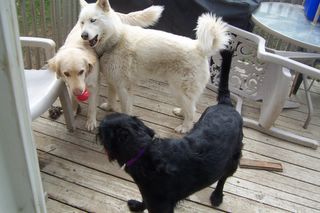
The Dog Gang

Emerson playing with his "yardmates" - Max (Pyrenees/Golden Retriever mix) & Kaylee (Labadoodle)

Emerson and his buddy Max (who is obsessed with his Kong and other toys that can be thrown).

Northwest Runner


April issue - page 29, "2005 Track and Field Preview: High School" . . . pg. 30-31 features the three profiles I wrote on Becca Noble, Laef Barnes, and Megan O'Reilly. www.nwrunner.com

Sunday, April 10, 2005

Reading Poetry & Writing Nonfiction

With two sore knees, the left worse than the right, and some achey hips as well, today is devoted to reading. Yesterday's geocache hike in Liberty Lake with some friends was very fun, however. Emerson loved it, as well, like he always does. (Judd and I found this easy geocache on my birthday.)

Today I'm enjoying spending time with Frank Bidart. At first, I wasn't too sure about his poems in his book, In the Western Night: Collected Poems 1965-1990. Jonathan recommended him to me because of the way Bidart uses typography, punctuation, and line layout like a screenplay, to direct the reading of his voices, to really clarify the tone, volume, and inflection (and thus, implied meaning) of his poems. Words in CAPS abound, as well as the use of dashes, elipses, parentheses, and semicolons. (The latter being something Richard Hugo highly disapproved of..."No semicolons. Semicolons indicate relationships that only idiots need defined by punctuation. Besides, they are ugly." - from Triggering Town, page 40 - Chapter 6, "Nuts and Bolts")

But after I started getting further into Bidart's book of poems, I better understood the format and intentions, and as I got better used to how Bidart writes and structures his poems, it was less foreign and I became more comfortable with them. I knew how to "read" his turns and techniques. I don't think I'm bold enough to start trying out CAPS (and the yelling voice that's implied) in my poems, but Bidart reaffirms that it's okay to still use the occasional italics and exclamation point to accentuate a voice or line of dialogue.

I'm also reading Joan Didion's nonfiction book Slouching Towards Bethlehem for my Nonfiction Form & Theory class, which I love. This class is a refreshing change from poetry, and I've always been interested in learning more about nonfiction writing. This class is meeting all my needs, in regards to introducing new knowlege, engaging texts to read, fascinating discussions and learning from my professor and classmates, and the in-class writing exercises that Natalie asks us to do. Jeremy wrote about our last class on April 7th. I volunteered to share what I wrote during our 20 or so minutes of writing time. I passed on the Wild Turkey.

The task: think of some realm, some group of people, some collective of which we have insider knowledge, and write about that in an effort to talk about some larger meaning.

My essay (at least the beginning of one):

Once a month on a Wednesday afternoon was the required faculty meeting. I usually never looked forward to these with authentic excitement. I would have rather used the time to get some much-needed grading done or left the school precisely at 3:05 p.m.—thirty minutes after the sixth period bell, the official end of the teacher workday.

By law, we teachers had to attend these meetings. Unless there was a very legitimate reason for not attending (such as being a coach and with after school practice to supervise), and only if there wasn’t an alternative morning meeting to attend, was a teacher really formally excused. Of course, sick days were always a good reason to miss one of these meetings. Therefore, the second Wednesday of the month was always a good day for using one of the twelve allotted teacher sick days of the year.

I usually took my time walking to the school library, always the designated setting for these meetings. I would first stop at the women’s faculty restroom for the necessary relief, sometimes my only pit stop of the day if I had a particularly hectic lunch break or planning period. The one thing I enjoyed most was the “field trip walk” in the hallway with my 2nd floor colleagues, as if we were finally happily released from our classroom prisons and given permission to socialize freely while still technically on the clock.

High school staff meetings at my school were a bit more exciting than the average suburban high school. At least that’s what I gathered from my friends who taught at other schools, in other districts. It wasn’t uncommon to have raised voices, people walking out, sarcastic comments flying across the room, and even arguing at our staff meetings. When I found out what my friends did at their staff meetings, I realized life could be worse—staff meetings could be long and boring.

My staff was a pleasant mix of young, mid-career, and old blood. One was considered a “new teacher” if under the age of 30 or with less than three years of teaching experience. The veteran faculty had been teaching for 15, 20, 25, even 30-plus years at this one school. Tom, my English department head, had been there so long he starting having second and third generation of students.

These veterans were brash, tough, defensive, non-bull shitters who were skeptical of the administrators—who generally rotated in and out of the school every few years, at least the assistant principals came and went more frequently. And these veterans were all people I admired. They defended us new teachers like we were their own flesh and blood.

And everyone knew who really held the power in that school, whose opinion really mattered most. Tom, Chuck from Social Studies, Helen from the Business department, Sue (also English, who was known for her occasional emotional outbursts and confessionals), Derek and Sharon (also English teachers). In fact, it was really the English Department who were the major renegades. Freethinkers, articulate debaters, argumentative (but always right), creative, and ultimately a subversive bunch—mainly due to Tom’s guidance and leadership.

Tom was a true gentleman, in addition to being a strong head honcho who stuck to his guns. He was a poet, a father, and our sugar daddy of sorts. He was known for his gentle compliments. “That’s a lovely gown you’re wearing today,” was commonly expressed whenever I wore a skirt or dress of any sort, instead of my usually khakis or nice jeans. Tom treated everyone with grace and respect, unless someone was really a jerk. But even then he was never mean to anyone, always gave people some form of quiet respect even when the weren’t deserving of it and even when they never showed respect to the rest of the staff.

Other departments, like Science, liked to roll their eyes at the English teachers. More than once you could hear a sigh or tsk of the tongue, when an English teacher spoke up at a meeting. They didn’t care for or even understand the importance of a passionate plea or speech during faculty meetings. They thought we were just a bunch of hippy poets or Thoreau activists. But really we just saw all the bullshit much clearer than everyone else.

After all, we English teachers were the ones who always had to proctor the state assessment tests, give the AIDS education speech to our students, help the kids with their registration each spring, refer kids to the counselors when they wrote suicidal poetry and turned them in as class assignments. And since our department had the highest failure rate, we also got the most heat.

“Don’t lower standards. Keep high expectations.” This was the rallying cry coming down from the district office and our principal. Then out the other side was the criticism, “Why are so many students failing English? What are you guys doing in your classes anyway?”

We all knew our failure rate was because our students were generally unmotivated and unskilled. They couldn’t read. They hated writing. They cared more about pot, their after school jobs, their cars, anything other than schoolwork and the education process. Or they had really hard home situations that made schoolwork one of the lesser priorities in their stressful lives. The Honors and AP classes were a totally different story. Those classes were the only ones who even closely resembled the ideal students, those imagined scenarios that university teacher-education programs prepared us for.

However, the district office and School Board kept blaming our school’s overall low achievement on the faculty—saying we were poor teachers. Or they blamed it on certain groups of kids, like the ESL or Special Ed kids (who were bringing down our collective image and achievement scores), or the “apartment kids” got the blame. (Never mind the district for revising the school boundaries so that a disproportionate number of apartment complexes fed into our high school so that we statistically had a much greater number of transient, low-income families versus our country club, new home development neighborhood populated rival high schools.)

Anyway, these faculty meetings were really just an excuse to make us to something—the whole conformity factor that so much of the American public school system depends on. It was like the absurd trend of making Fridays “School Spirit” day and asking staff to wear school colors and mascot t-shirts. We weren’t high school students anymore, this was our job.

Friday, April 08, 2005

what I am


Sanguine Personality type with Powerful Choleric as runner-up (when I'm especially stressed, busy, or motivated I can really see this) ... more about what all this means... and which type I'm marrying (I think...I'll find out for sure tonight!).

Thursday, April 07, 2005


for an MFA poetry student, every month is Poetry month, every week, every day ... and those days that we only seem to take a break from it by not composing or reading something, we're still thinking about it, storing images in our heads and composing in our minds....it never ends until the Thesis Defense...and even after that it will continue on with joy

Wednesday, April 06, 2005

poetry and religion

I've been thinking about the poet Julia Kasdorf, how she's become a voice for the Mennonite community. And I've been thinking about the Pope's death--in an abstract way, as a former Catholic kid who grew up hearing about what Pope John Paul said or did, and how that related to our "faith" and the "Church" and what we were supposed to believe. And I met a guy once who's name was Jon (short for Jonathan) Paul...and I joked that he was named after the Pope...then I found out his dad was really devoutly Catholic, and that yes, indeed he was sort of named after the Pope.

And I came across this interesting article, "Putting Pop Culture Behind the Pulpit."

So I then googled "Poetry and Religion" and found some interesting links to explore...a blog with a poetry book anthology recommendation, some Mars Hill audio sermons, a lit mag website--"Pleiades: A Journal of New Writing" that includes "Christianity and Poetry:A Symposium"...and that was about it for the most interesting stuff.

The back issues of Pleiades sound fascinating...I want to find them and read them. I'll have to see if the Willow Springs reading room has any copies.

as if the internet couldn't get any weirder!

Your Ideal Hairstyle: Sliced Layers


What Hairstyle Is Right For You? Take This Quiz :-)

Tuesday, April 05, 2005


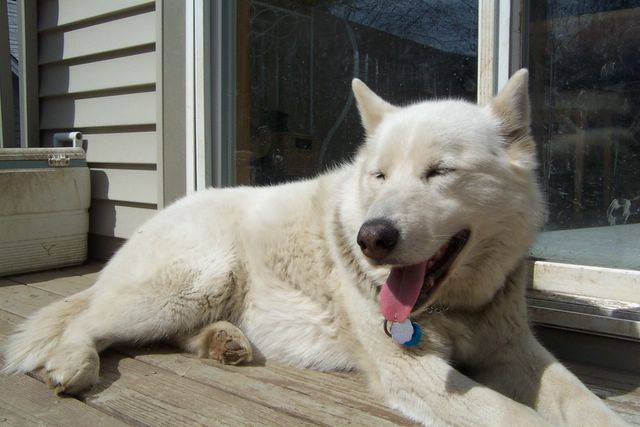
Emerson loves to nap in the sunshine on the warm wood.

Emerson says, "It's hot!"

great book

This book was on display at the local library for their little "National Poetry Month" table...and I've really enjoyed it. There's some great new poets in here, well new to me, though the book was published five years ago.

I think Julia Kasdorf might be my new favorite poet. Her poem "Eve's Striptease" is hilarious, beautiful, and filled with surprising imagery. I'm jealous I didn't write it. I just bought two of her poetry books and can't wait for Amazon to deliver them.

Jeffrey McDaniel, James Harms, Allison Joseph (another good link for her), Ann Townsend, and HeidiLynn Nilsson are also wonderful new discoveries for me. I'm very excited to complete my thesis reading list. May the US Postal Service be swift and strong.

things I love, things to be thankful for

spring weather, bike rides on the Centennial Trail, barbecue chicken, good wine, daylight savings, guitar playing, worship songs...wedding planning...making plans, making decisions, crossing things off the To Do list...soft rainfall...craft stores, sales at craft stores...chiropractic care...my engagement ring and what it symbolizes...new babies, little girls, nieces, Ellie Jane - 8lbs 13 oz...new poems, newly discovered poets, thesis advisor, non-fiction form and theory class, Get Lit!...love poems, best friends, the color Cranberry, half-price day-old muffins, a newly pregant friend, a freshly laundered t-shirt...All you can eat salad at Olive Garden...spending time with my fiancé