Ever have one of those days where it feels like you can't move fast enough? Where it seems like everything is taking longer than it should be? Like your mind is moving a faster rate than your body is willing or even able to do? You're continually planning out and envisioning the next 60 seconds of your life and you just can't keep up?
Well, that's what today felt like. It seemed like I couldn't even refill my dog's water bowl as fast as I wanted to. I was impatient with each present task, knowing there were so many more to do. There was no seconds to waste.
Thesis anxiety is kicking in as the final 8 days approach to the deadline to give a complete photocopied manuscript to each of my committee members. At that time, I also need to provide them with a confirmed list of my thesis book list--15 titles in all. My oh my.
It will all get done...the optimistic corner of my brain knows that and repeatedly chants this to myself. I might be wearing the same cycle of clothes and not brushing my hair very often over this next week, but the thesis will get done. It has to. Sleep can always be sacrificed.
Yet, the quarter still moves on...and I'm attempting to keep up with the reading for my NF form/theory class. I'm liking Annie Dillard's Pilgrim at Tinker Creek, however, I'm only getting her in short doses so far. Tomorrow, I'm planning to read the book in larger chunks of time. On Saturday evening as I was reading the book and marking passages and lines I liked with a newly-sharpened pencil, my fiance's 4-year-old niece Emma (and my future wedding flowergirl) came alongside my chair and said to me, "You're writing in your Bible?!" I guess it is a pretty thick book...but I explained to her that it was a story book for school. "You go to school?!" she exclaimed. Emma goes to pre-school and has recently learned all about ladybugs--their wings, life cycle, etc. (Her rich and vibrant vocabularly rivals the men in the family.)
As I explained that I go to college, just like her mommy and daddy went to college, she paused to exclaim (most statements are a genuine exclamation for Emma), "My mommy and daddy went to college?!" I'm not sure what Emma's concept of college is.
Considering that Dillard is fairly spiritual (I learned that she was raised Presbyterian than converted to Catholicism as an adult), Emma's question about me writing in my Bible is interesting.
Nonetheless, I was quickly swayed into playing with Emma. What adult can resist a cute little girl asking, "Do you want to play with me?" She led me downstairs to the playroom and we enjoyed multiple rounds of "Simon Says." She let me go first at being "Simon" and she rotated our turns equally. My favorite of her requests, "Simon says: pretend like you're buckling your shoes." Then we played hide-n-seek, my personal favorite. The first time I was "it", I had to count to 5 and 1/2. I tried to pretend like I didn't know where she was hiding, though it was obvious from the sounds that she was behind the chair in the same room we were in. So, as I pretended to look for her under the table, she squealed, "I'm behind the chair!" The next time it was my turn to count, I had to count to 33. Obviously, she had a much tougher hiding place in mind. But before I could really look for her, she called out, "I'm in Papa's closet!" Oh, the joy of being four years old. That sweet, simple exhiliration of hide-n-seek. The suspense of waiting in a special hiding place and then the "surprise" of being found.
As a result, Dillard received little of my attention the rest of that evening.
This week I'm also reading Paul Guest's first book of poetry, The Resurrection of the Body and the Ruin of the World. Paul has a recent poem on Slate, and also has a blog! So far I'm only on page 33 of his book, but am enjoying it--as Jonathan said I would. I'll discuss it more with him on Thursday for our second thesis advising meeting this week.
Good night! It's one of those rare evenings in Spokane where it's raining really, really hard. It's like Seattle. Ah.
Monday, May 09, 2005


Friday, May 06, 2005
parody
I read about this in the paper, and had to visit the Wal-Mart parody website for myself. Great job to the college kid who did all this!
I read Nickeled and Dimed: On (Not) Getting By in America in the spring of 2003. I rarely shopped at Wal-Mart anyway, but after reading Barbara Ehrenreich's book I made a more informed decision to not support their corporation every again. (Sadly, the great novel and movie Where the Heart Is ends up glorifying the business in a spoof-like way.)
I admit, however, that I've shopped there at least 2 times since reading the book: once because I received a $50 gift card for a Christmas present and I bought much-needed groceries there, and another time I bought the Friends DVD there for my fiance's birthday present (it was the cheapest price I could find, except Amazon but I didn't have time to buy it from them), Valentine's Day boxers, and a pint of raspberry sorbet. (Really, what other store would allow me to purchase all of these items in one trip? Okay, maybe Fred Meyer.) I felt sort of bad about this second purchase, but it was also a financial relief to my budget in a way. However, I'm happy to say I've been "Wal-Mart Free" for over three months now, and I don't plan to go back. That's right. Never, ever again.
I've been trying to get my mom to stop shopping at this mega-retail giant and read Ehrenreich's book because she's a big Wal-Mart fan, but so far I've been unsuccessful. The store was next to the "Super Mall" so what could I do? And now a new one opened up this winter that's even closer to her house! Wal-Mart is the new K-Mart. I didn't grow up with Wal-Mart like kids in the South did, or like my nieces have now. Washington state kids in the 1980's didn't like to admit their mothers shopped there, and we took our P.E. clothes to school in the best plastic bags we could find (The Bon or Nordstrom were the coolest, the specialized bags from their junior departments). I remember quickly grabbing a bag from the pantry and only finding out later when I was at school that it was a K-Mart one. I was mortified and made sure no one saw it!!
Thursday, May 05, 2005
bad poem
Just for the record, I don't think "Kissing John McPhee" is a good poem. It would get an enthusiastic rejection from me if it were to be submitted to Willow Springs. It's sentimental, melodramatic, and its predictable details about McPhee's life as a writer sucks any intriguing tension that might otherwise exist between the speaker and the situation. I don't think it's trying to be ironic or sarcastic, it seems to be a sincere attempt to be a form of author-worship, which makes it all the more cheesy. And the fact that McPhee wrote for The New Yorker, and just recently had a new essay published in it, makes it all the more cheesy. But, I must admit, you gotta admire a writer who writes poems for other writers and submits them to a magazine as big and prestigous as THE NEW YORKER!! And then documents (announces?) those submissions and rejections on her own blog! Now, that takes guts. (I'll keep my bad poems and rejection slips to myself, thank you very much.)
After NF form/theory class tonight and Jeremy's presentation on McPhee and his book (The Survival of the Bark Canoe), Jeremy suggested I write my own version of "Kissing John McPhee." I considered, but instead thought I'd rather write a poem called "Kissing Henri" (pronounced "on-ree", for those like me who aren't familiar with French names). But now it's late, and I can't muster the energy to write it, even though I drank Mountain Dew during class.
But if I were to write about my experience of reading McPhee's nonfiction book for class, it might go something like this...
Kissing Henri
Maine's wilderness and Thoreau, and now this:
sympathetic portrait
of twenty-five year old Henri,
lonely in his art, unmarried and still living
with his parents in his New Hampshire hometown.
He carved wood, remembered the best trees,
was obsessed with only this.
A white man seeking
mastery of the Indian bark-canoe.
I know it's hard to let go what you create.
Green beef jerkey breath,
faint orange stain
of Tang on your lips
and pressed
into the side creases
of your mouth,
please paddle faster for me.
Nonfiction Book of the Week

Subgenre: Research-Based Literary Nonfiction
- the details, the author and his writing life, and a poem called "Kissing John McPhee"
MFA choices
If I had to start all over, if I hadn't been at Eastern the past two years, I would strongly consider this program. A very intriguing philosophy. At the same time, any MFA program is what the writer makes of it. In my MFA program, I've been fortunate to have a number of classmates who also write from the foundations of the Judeo-Christian belief system. Though I wish there was greater opportunity for more organized discussion about this, it's come up. In Poetry II, Modernism Form & Theory, some of these ideas came up. And anytime a text alludes to Biblical themes or characters, this has been discussed.
One thing I know for sure, I love the residency MFA program. Moving to a new city to join a community of writers (while also making a newer community, as the incoming group of students), the bi-quarterly "Voice Over" events, the visiting writers, the after-parties, meeting for class each week, the internships (the university press, teaching/Writers in the Community, and literary magazine editing), the literary magazine editor meetings, meeting classmates for coffee, going for runs together, being immersed in the culture of writing...this is only possible with a program where we all come together face to face to live the writing life...especially for someone like me, who I would consider to be not such a traditional graduate student. I started grad school at age 28 (almost 29) after having a full-time public school teaching career for 5 years + a one-year sabbatical (hiatus/escape was more like it!) from the English classroom to work at a Christian camp for a year (marketing & promotions) . I didn't come right from my undergraduate studies, or come after obtaining a different master's degree first. I needed the routine, the motivation of community, the regular social interaction with professors and classmates. I have a friend in a low-residency MFA program for creative non-fiction. It wasn't her first choice, but her and her husband had established jobs in Seattle (hers already involved writing...to pay the bills).
Unless one chooses the research-based UW program or the UW certificate-program (not a credited degree, and far from an MFA course of study), then the choices were limited to low-residency programs. Now, Seattle area writers who want to pursue their MFA can choose from SPU's newly-created MFA program, the low-residency at PLU (which only began in 2004), move to Bellingham and get a MA in English with a Creative Writing emphasis at WWU, come to Eastern, pursue an out-of-state low-residency program or move out of state for a residency MFA program.
Sadly, I'm not quite ready for my experience to end. I now know why it's not such a bad thing to extend the thesis another quarter.
More MFA food for thought:
Wednesday, May 04, 2005

Franz Wright, winner of the Second Annual Denise Levertov Award from Image Journal of the Arts and Religion speaks on Tuesday, May 17 at 7:30 pm at the Seattle Art Museum. Free. Public reception, celebration and booksigning follows.
For more information, see http://www.imagejournal.org/news/local.asp
"Image journal and the Department of English at Seattle Pacific University established the Levertov Award to honor one of the twentieth century's greatest poets. Levertov, who spent her last years in Seattle , embraced the landscape and culture of the Pacific Northwest. Levertov's identity as a Christian believer—a pilgrim whose faith was inextricably entwined with doubt—became another important facet of her work, particularly in her later poetry.
The Levertov Award is given annually to an artist or creative writer whose work exemplifies a serious and sustained engagement with the Judeo-Christian tradition."
Monday, May 02, 2005



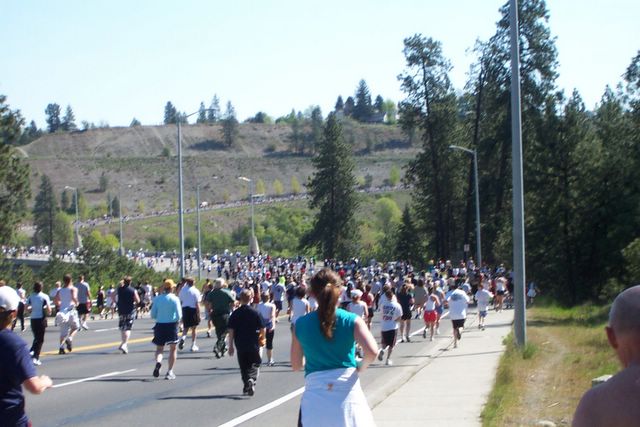
finish line
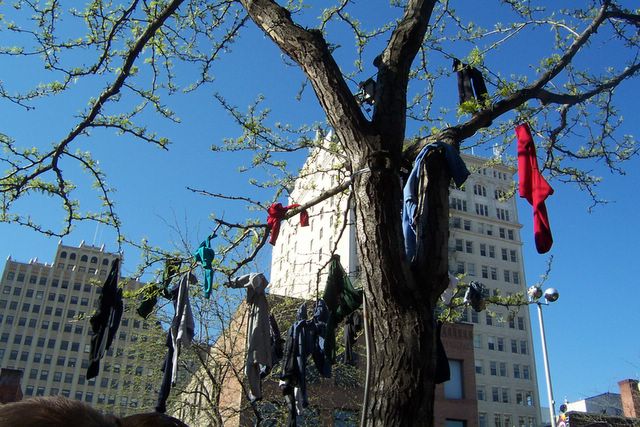
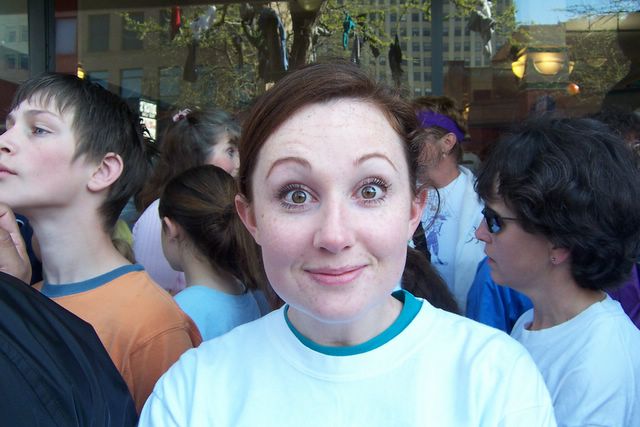
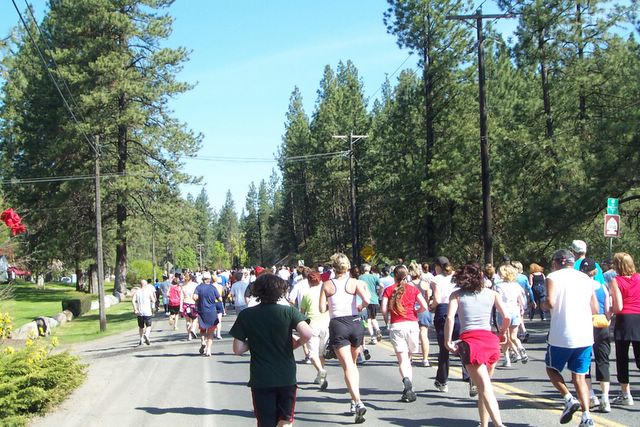
Judd took our "finisher" pictures...we all looked marvelous and had a wonderful time. Check out the upcoming June issue of Northwest Runner magazine for my Bloomsday article and an interview with Don Kardong, this year's new Race Director and Bloomsday Race Founder/former Olympian.
Thursday, April 28, 2005
bizness of writing (get to work!)
I'll be writing an article about Don Kardong & Bloomsday, which is due to my editor/publisher by May 9th. Don called me last night and we tentatively have an interview set up for the Wednesday after the race, which is this Sunday. I'll need to take notes at the trade show Friday night and since Don gave me his cell phone number to contact him during the busy race weekend, I'd like to track him down and take his picture--preferably on race day...even sweeter if it was post-race with the overall winners, but even better if it was a picture of Don with the top male and female finishers who are Washingtonians, or at least from the Northwest since it is for Northwest Runner magazine. But I'll still be on the course during the awards ceremony, most likely, since the elite runners finish the 12k course in awesome time. And I'm not willing to give up my entry (and not get the finisher shirt!) just for the sake of journalism!
In the meantime, poetry, poetry, memoir, poetry, non-fiction, poetry, poetry, poetry...
POETRY THESIS MANUSCRIPT DUE IN 20 DAYS!
My reading list is moving right along...in fact, I keep reading more and adding more books to the list. The most difficult part will be deciding which 15 to keep on the list.
And I recently finished Modern Ocean the first book of poems published by James Harms. I LOVED it!! Really intriguing poems, what I would defend as being narrative lyric poems, mostly about growing up and living in San Diego CA. The setting is there, but the culture and family around the speaker of these poems is what is most engaging, and which is the core of the subject. There is a balanced mixture of light and dark (as in the yin/yang//good/evil emotional forces of life and human experience). Harms is a master of subtle emotional tensions, understating the conflict to really pull the reader into his poems and construct a co-experience...as I read, I felt like I was discovering meaning alongside the speaker--a co-creator of the experience, through the poet's use of point of view and tense. Wow! I'm excited to share with Jonathan how much I really, really loved this book! I see much of what I'm attempting to do in my own work, being done in Harms' book. He nails it right on.
Monday, April 25, 2005
Memoir
I've enjoyed researching and studying the nonfiction subgenre of memoir, in preparation for an informal presentation that a classmate and I are preparing for Thursday night's theory class. The text basis for our discussion is A Unfinished Woman by Lillian Hellman, a controversial memoir.
I'd like to re-read some of the memoirs that I've read in the past (such as A Girl Named Zippy by Haven Kimmel). I read them without really considering it's authentic literary value beyond the pure entertainment of the narrative and characters. Moreover, I never thought to seriously question how or why the memoir was being written. I read with an easy kind of faith.
Here are some of the websites where we've gathered information from:
- Memoir, a explanatory definition of the subgenre
- A New York Times Magazine article from 1996, "Confessing for Voyeurs: The Age of The Literary Memoir Is Now" by James Atlas
- a review from 2000 of Dave Eggers and his "ironical memoir"
- Judith Barrington's Writing the Memoir: From Truth to Art
and for any teachers out there... a high school memoir writing unit plan
thesis bond paper
For those Spokanites who are writing your thesis this quarter or in the near future, here's a place to purchase your 100% cotton thesis bond paper. I'm not exactly sure if Paper Plus is cheaper than the school bookstore, but if you buy it on a Monday and mention the Spirit 101.9 fm radio ad, you get an extra 10% off. A pack of 500 sheets (of 24 lb text weight) is $32.35, before the discount.
Friday, April 22, 2005
Sedaris slept overnight in Spokane
First...I admit it: I sometimes plan too many things for one day, my To Do is a tad unrealistic. I'm optimistic and underestimate the time needed and the actual time I have. I overestimate my stamina and ability to stay focused and on-task; other opportunities arise and I say "yes" to them.
But I did meet David Sedaris yesterday. He is smaller than I imagined him to be. Shorter, yes, but also just a smaller presence (maybe small head, too), and smaller-boned, which doesn't seem to fit his writing which is bold and declarative and in-your-face funny. And the pictures of him on the back of his book make him look tall and skinny. But really, he's just skinny and kind of short, for a guy. (See Jeremy's pictures.)
I took a brief break from taking tickets at the door and cut in line in front of Ashley (another MFA poet) to ask Sedaris to sign my copy of Barrel Fever. (Before leaving my house, after franticly looking for my copy of Holidays on Ice, I remembered that I loaned it to my mother and it's still sitting on the guest-room dresser at their house near Seattle.)
Sedaris asked me, "What's that smell? You smell 'fresh'." I was confused for a second, then felt somewhat embarrased when I remembered that I had sprayed some Victoria Secret's "Love Spell" (the purple bottle) on my skin. My fiance hates it, says it smells like canteloupe and he hates canteloupe. He calls it "Love Repell" and so I only wear it when I'm not going to be anywhere near my fiance. That's why I impulsively put a little on before dashing downtown. (I only have a little over three months to use up the last of it.)
So I ended up telling Sedaris the whole story behind the smell. He chuckled as put two mushroom stamps on the title page of my book (my copy of his book) and signed it for me. I thought he might mention something about me having the same name as his sister, and how much he loves that name. But he didn't. Instead, I blabbed about "Love Spell" as the next five people in line heard my story as well. I think a fit of nervousness came over me. But at least I made Sedaris laugh!
During the Q & A, he talked about how he likes to ask a question of each person who asks him to sign a book. Maybe he'll put our encounter in his diary and read that at a future reading.
April 22, 2005: Spokane, WA
This woman in the book signing line came up to me and smelled, so I asked her, "What's that smell?" . . . .
Hopefully he didn't find it repulsive. He did roll his eyes around in circles when I told him it was called "Love Spell" as if to mimic its name. He probably did find it bearable, at least, or else he wouldn't have brought it up.
Which reminds me that I had to sit near a really smell man throughout the entire Sedaris reading, and it burned my eyes. As a volunteer, I didn't have a seat for the sold-out show. So I had to either stand in the back or sit on the floor. I found a little nook in the back handicapped section, which was actually used for overflow seating. I was told there would be no late seating, but during the second essay or so this man was escorted into our area and given a metal seat (like those found in church basements) to sit on. It was too dark to see what he looked like, and I didn't want to be rude and stare, and I wanted to stay focused on what Sedaris was reading onstage. But as soon as he sat down, everything came wafting towards me. It immediately made me think to myself, "Is this man homeless?" He had dreadlock like hair, I could tell that much. Maybe it was his shoes, more than body odor. It was like how my wet socks smell after a two-day backpacking trip. It was a sour, pungent smell, and wasn't that horrible compared to what it could have been. I realized that is why the man's seat was placed behind where I was sitting, against the wall, rather than next to the other chairs and the guests sitting in rows. There was obvious room for his chair to join their rows. The man who escorted him there, the theatre manager I think, must have known he smelled. Since tickets were $40 for non-students, I couldn't figure out how this man got there. Maybe he didn't know his shoes were so stinky. And of course, since I was sitting on the floor, maybe I was the only person who realized it. He had a deep laugh and expressed it heartily throughout the rest of the reading. I was glad he was enjoying himself. Later, I saw him in the balcony drinking a can of pop and walking back down to the first level. He staggered like a drunk. Maybe that wasn't soda in the can. Again, it was too dark to tell. But his skin looked clean enough. It was bizarre.
After Sedaris, the rest of the evening was not very interesting. What reader (either nonfiction writer or poet) wants to follow Sedaris? Of course they won't be as funny! I was too impressed by Sedaris, who I'm sure shocked the Spokane crowd with his "dirty" essays (as he referred to one, after reading it), to be objective to the two other guys. And over half of the 700-person audience had left at intermission.
Still, it was a worthwhile evening. New York doesn't come to Spokane very often. And it's really, really interesting to see who comes to see a writer like Sedaris. It's like all the cool literary readers of Spokane were at the Met, along with all the devoted NPR listeners from Moses Lake to Couer d'Alene--a mostly grey-haired crowd, I think. This one woman, also sitting in my area, laughed so loud. She was the loudest in the theatre. I would watch her and thought she was going to fall back in her chair, her guffaws were so forceful. And she was a big woman. When Sedaris said, before wrapping up the Q & A, "If Sues is here, I'll see you at the front," she yelled, "Yay!"
P.S. I did finish my Lopate technique journal, had a great run with Emerson (it was so warm and sunny I wore shorts & T-shirt for the first time since Sept.), I thought about poetry, did an errand at Paper Plus (to solve a problem that arose unexpectedly), and went grocery shopping after Sedaris.
Thursday, April 21, 2005
To Do:
- finish reading Phillip Lopate's book of selected writings, Getting Personal and write a one-page technique journal for class (an interesting review, won't let it taint my opinion though)
- finish reading Ann Townsend's book of poetry Dime Store Erotics
- start reading Modern Ocean, James Harms's first book of poetry
- work on revision for one particular poem that's been on the table for almost 2 weeks now
- finish reading this week's submissions for Willow Springs (which aren't really "this week's" but it's what I took to read, really they were sent a few weeks ago, or a month or more...that lit mag backlog, or slush pile...it just adds us)
- fit in a run with Emerson somewhere in the day
- go grocery shopping: basics needed...milk, bread, bananas, deli meat and cheese
- stop by school to turn in paper for class and Willow Springs submissions
- volunteer at Get Lit! and meet David Sedaris after his reading
- brainstorm what treats to bring to class next week as penance for missing class for Sedaris
Think I can do it all in one day?
Subscribe to:
Posts (Atom)